USE OF PHEROMONES IN
BEEKEEPING
By John Pedersen of Pedersen
Apiaries
In a recent
issue of Speedy Bee, the editor, Mr. Troy Fore, asserted that there have
been relatively few beekeeping innovations in the Twentieth Century (Fore,
1999). His thesis is that the great majority of beekeeping technologies,
which we enjoy today, are merely refinements, in quality or scale, or both,
of earlier, mainly Nineteenth Century inventions. His short list of
truly Twentieth Century developments did not include the effort that has
been expended on the study and synthesis of some of the natural honey bee
pheromones. Here I wish to discuss the use of pheromones in beekeeping;
specifically – Queen Mandibular Pheromone (QMP) and, to a lesser extent,
the Nasonov pheromone (Blum, 1992).
Dr. Mark Winston and his team,
working at Simon Fraser University (Burnaby, British Columbia, Canada), were
able to synthesize the QMP pheromone (Winston et. Al., 1992). This
discovery was patented and Phero Tech Inc. of Delta, B.C. was licensed to
produce the pheromone. QMP is the active ingredient of two Phero Tech
products: BEE BOOST for honey bee management; and, FRUIT BOOST
for enhanced crop pollination.
Pedersen Apiaries is a family
corporation engaged in commercial beekeeping located in west-central Saskatchewan.
Involved in this operation are my two brothers, Edmund Pedersen, Gilbert Pedersen,
Gil’s daughter Karen, and myself. We are basically involved in honey
production and, to a lesser extent, queen raising. We have been raising
queens for more than 10 years – initially, for our own replacement needs
only but, as experience has been accumulated, for sale to other beekeepers.
Our queen sales have increased steadily over the last several years and include
beekeepers in most Canadian provinces. The scale of the operation requires
the use of many mating units to ensure the required supply of mated queens.
Early in the game we decided,
for reasons of economy, to use small nucleus hives, or “baby nucs” for queen
mating purposes. After experimenting with several designs, we settled
on a twin unit with over all dimensions of 508 mm long x 245 mm wide
x 140 mm deep. This is divided into two compartments, each of which
measure, on the inside, 235 mm x 205 mm x 140 mm. Each compartment
has five small combs designed to fit within this space. We now have
500 of these twin units, or the capacity to have up to 1,000 queens mated
at each round of queen cell introduction.
|
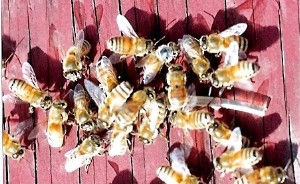
Testing a BEE BOOST
strip by laying it on a hive lid.
Several bees are investigating
the strip after a few minutes.
|
|
Getting bees
established in these small nucs at the geginning of the season has been an
ongoing problem. Over the years we have tried various methods to overcome
this difficulty. One solution was to introduce laying queens, with
some bees into one or more of the nucs. As the queen lays eggs, the
individual combs and adhering bees can be removed and used to establish a
new nuc. A queen cell is than introrduced to this new nuc. Extra
bees must then be added to the original unit with the laying queeen.
This system works, but is slow and cumbersome. Another method we tried
was to take the empty nucs out to the regular bee yards and dump bees into
the units. Then the nucs were taken back to the mating yards and queen
cells introduced. In theory, the queen peromones adhering to the viable
cells will serve to keep the bees in these nucs. In practice what happens
is that, prior to queen emergence, the bees will tend to abandon some nucs
and drift to others. So in a mating yard you will end up with some
over populated nucs and some with no bees at all.
At the Saskatchewan
Beekeepers Association annual conference in Saskatoon in February of 1996,
Doug McCutchion, was present with his display of Bee Books and Things.
Among his stock of posters of bees and related sub jects, and many books
devoted to beekeeping, he also had some samples of BEE BOOST, plastic
strips impregnated with Queen Mandibular Pheromone (QMP). Phero Tech
Inc. produces and markets BEE BOOST with QMP. Doug and I discussed
the merits of this product as a possible solution to our problems in maintaining
mating nucs. I decided to use the BEE BOOST on a trial basis. Accordingly,
I purchased a package of 50 BEE BOOST strips. Later that same winter
I attended the Bee Masters Short Course at Simon Fraser University. Here,
Dr. Winston gave a discourse on his team's effort in isolating and synthesizing
the QMP. If I had not already committed myself to a trial, this would have
convinced me to do so.
|
| QMP in
Mating Nucs:
To make a long story
somewhat shorter, in May of 1996, we began using the BEE BOOST strips
on a random basis when populating the baby nucs at the start of the queen
mating program. A hand tacker is used to drive a staple into the wood over
the center of the BEE BOOST strip. After observing the nucs with
BEE BOOST and comparing them with the nucs without such an aid,
we came to the conclusion that the BEE BOOST with QMP was indeed all
that it was claimed to be. There was no significant drift among the nucs
with the strips, while the units without the strips were as uneven as in
previous years. We immediately phoned Doug to mail another 200 strips. Since
this time we have ordered a minimum of 250 BEE BOOST each spring.
BEE BOOST strips are left in the mating nucs until there is
brood. There is no concerted effort made to remove all of the strips immediately.
Instead, they are removed as opportunity permits, generally while the nucs
are being examined to catch and remove the queens. It doesn't seem to be
a big deal if BEE BOOST strips are left in the nucs all summer.
QMP in Swarm Traps:
In addition to the
use of the BEE BOOST in the mating nucs, we also utilize a few of
them in swarm traps. Swarm traps are made up by using an old super to which
a plywood bottom has been solidly attached. A hole of about 25-30mm
is drilled in the center of one of the long sides. Nine old brood combs are
then placed in this unit and a cover placed over the top. We generally use
two of these traps in each yard, placed at least a meter off the ground. The
BEE BOOST strips are stapled to the top bar of a frame in the
swarm trap. That first season we only used BEE BOOST in the traps,
with somewhat indifferent success. Some of the traps with BEE BOOST
strips attracted swarms, but so did some of the traps that had no strips.
|
|
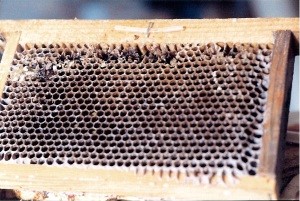 Baby nuc comb with BEE BOOST
stapled to top bar.
Baby nuc comb with BEE BOOST
stapled to top bar. |
| In discussing this problem
with Doug McCutcheon, he suggested that in swarm traps we try, in addition
to the BEE BOOST, another Phero Tech product - Nasonov pheromone baits
(trade name SWARM CATCH with Nasonov). We did buy a few of these and
used them the next season as an experiment. We set up some traps using both
BEE BOOST (QMP) and SWARM CATCH (Nasonov) lures, some
with only SWARM CATCH baits, and some with no lures at all. On balance,
the use of the two lures together seems to attract more swarms than any other
combination.
QMP to attract "Straggler
Bees":
In addition to their
use in mating nucs and swarm traps, we used BEE BOOST strips to attract
bees that may be brought in with the honey supers during extracting season.
Our hot room has large windows on both the east and west sides. Bees definitely
go to this source of natural light. To facilitate the collection of these
bees, we have mounted brackets over each of these windows. The brackets hold
regular five-frame nucs, from which the bottom has been removed.
Thus the bees can fly or crawl directly from the window up into these nucs.
When we first employed this system, we used a live queen in a queen cage placed
between the top bars. The presence of this queen keeps the bees in the nuc.
When the nuc is reasonably full of bees, it is removed from the brackets,
taken outside, and the bees are dumped into a hive set up for this purpose.
Once we acquired the BEE BOOST strips, we substituted them for the
live queens. The BEE BOOST works as well as a live queen to hold bees
in these nucs, but with a lot less bother.
|
|
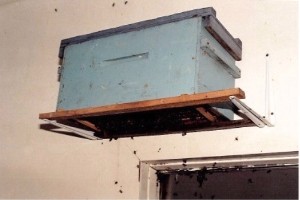
Five-framed nuc mounted
on brackets over window
to capture bees brought
in with honey supers.
|
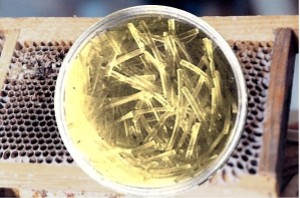
Plastic container filled
with used BEE BOOST strips.
This is stored in a
deep freeze when strips are not
needed in baby nucs
or other applications.
|
|
QMP to ship Queenless
Packages:
During this last season
we have been introduced to another use for BEE BOOST. Previously,
to facilitate rapid build up of cell builder hives we would continuously
rob brood and bees from other strong hives and add the combs and bees to
the cell builders: This works but it tends to reduce the potential for these
other hives to build up fast and be ready for the beginning of honey flow.
In order to alleviate this situation, we decided to try a different approach.
The idea was to add one or two packages of bees to each of the cell builder
hives before queen raising was to begin. This would, thereby, strengthen these
hives without the borrowing of brood from other hives as done previously.
To this end, we ordered 50 queenless packages from New Zealand. These packages
were shipped with a QMP strip instead of a regular queen. The packages came
through in great shape, with no apparent demoralization due to "queenlessness".
The experiment was a success and we intend to use this method from now on
in our queen raising operation.
Phero Tech Inc., the
manufacturers of BEE BOOST, claims that the strips retain their potency
for approximately a month. In practice I find this to be vastly under stated.
There is a very simple test to determine whether the strips retain their
attraction to bees. Merely toss the strips in question down on a surface,
such as a hive cover, where bees have access to them. If no bees collect
around the strip, you can conclude that it is no longer of any use. But,
it has been my experience that the strips retain their attractiveness to
bees, and thus their usefulness, for more than one month. I store used strips
in sealed plastic containers in a deep freeze between uses.
|
On the subject of life expectancy
of the BEE BOOST strips, the first summer after purchasing strips,
we had a dramatic example of their potency. Ed was adding strips to combs
in a swarm trap in one yard to see if they would attract swarms. In the process
of his work he accidentally dropped a couple of strips into tall grass at
the edge of the yard. Deeming it uneconomical to try searching for such small
items in the deep grass, he just left them lie. His main purpose in the yard
that day was to tip off all the full honey supers. When he returned to the
yard the next morning to pickup the supers, now free of bees, he found a
huge cluster of bees on the grass and small shrubs where he had dropped the
BEE BOOST. There were enough bees in this cluster to populate three
new hives. After collecting the last of the bees, we searched the ground
where the cluster seemed to be centered. Sure enough, the two errant strips
were located. This time they were retrieved so there would be no repeat performance.
We believe that both the QMP
(BEE BOOST) and the Nasanov (SWARM CATCH) pheromones are very
important tools for use in beekeeping. There is no question as to the effectiveness
of the BEE BOOST in holding bees in queenless units. The SWARM
CATCH lures, while not as unequivocally effective as the BEE BOOST
strips, still have an overall positive value in attracting swarms into swarm
traps. Because of the evident longevity of these products, we consider that
the cost is negligible when compared with their importance. Pheromones are
a very important addition to beekeeping technology in the twentieth century.
It is safe to assume that their usefulness will continue into the future.
For additional information
about BEE BOOST, SWARM CATCH and FRUIT BOOST, please
contact Phero Tech Inc. at 1-800-665-0076, sales@pherotech.com, www.pherotech.com.
REFERENCES
Fore, T.H. 1999. The
Foreward. The Speedy Bee. April issue.
Blum, M.S. 1992. Honey
bee pheromones in The Hive and the Honey Bee, revised edition (Dadant
and Sons: Hamilton, Illinois), pages 385-389.
Winston, M.L.; and K.N.
Slessor. 1992. The essence of royalty: honey bee queen pheromone. American
Scientist. 80:374-385.
Published in American Bee Journal,
Volume 140, No. 5, May 2000, pp.381-383.
Published in Canadian Beekeeping,
Volume 21, No. 7, Spring 2000, pp.157-159.
top
|
Revised: February 12, 2015.
Copyright © 2002 Pedersen Apiaries. All
rights reserved.
Original Design & Graphics by Karen Pedersen
Photographic images are under copyright and used
with permission of John Pedersen
|